
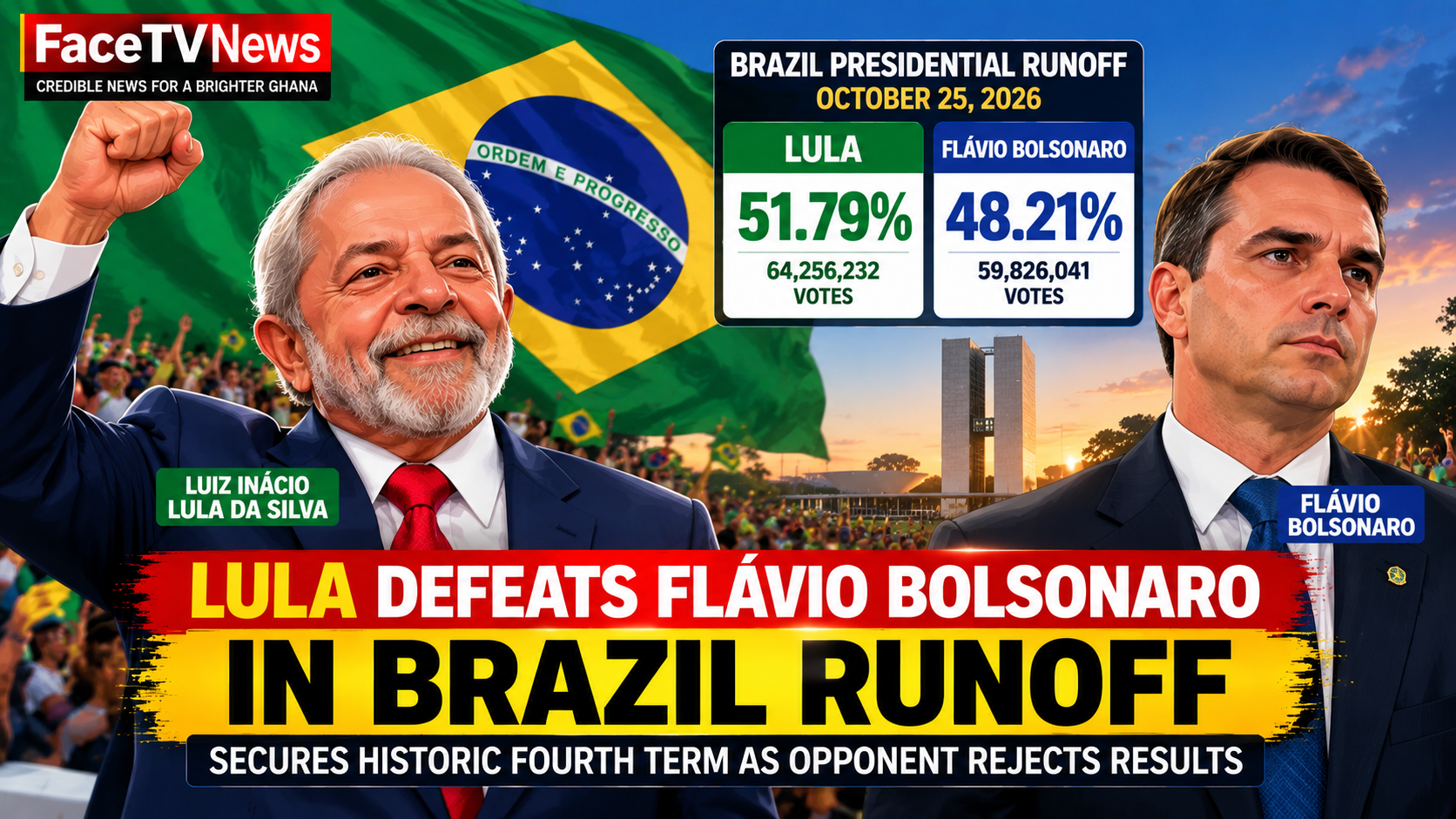
Brazilian President Luiz Inácio Lula da Silva has secured a historic fourth presidential term after defeating Senator Flávio Bolsonaro in a closely contested runoff election, although his opponent has refused to accept the outcome and is demanding that the result be annulled.
The election, held on Sunday, October 25, 2026, concluded with Lula receiving 51.79% of valid votes against Bolsonaro’s 48.21%, according to figures announced by Brazil’s Superior Electoral Court.
Lula received 64,256,232 votes, while Bolsonaro secured 59,826,041, leaving a difference of more than 4.4 million votes.
The outcome represents a remarkable political comeback for the 80-year-old president, who entered the second round after finishing behind Bolsonaro in the first round.
Lula Overturns First-Round Defeat to Win Presidency
The presidential contest had appeared increasingly difficult for Lula following the opening round on October 4.
Flávio Bolsonaro, the son of former President Jair Bolsonaro, emerged ahead with approximately 47% of valid votes, while Lula received about 45%.
However, neither candidate secured the majority required to win outright, forcing the election into a runoff.
Over the following three weeks, Lula’s campaign intensified its efforts to mobilise supporters, particularly through grassroots organising, public rallies and digital communication.
The strategy helped the president reverse the first-round result and secure another term.
His victory marks the first time since Brazil’s return to democracy in 1985 that a presidential candidate has recovered from a first-round defeat to win the runoff.
Flávio Bolsonaro Refuses to Concede
Despite the official declaration, Flávio Bolsonaro has rejected the election outcome.
The senator has challenged a last-minute judicial decision to extend voting hours following reports of disruptions affecting voters in parts of the country.
Bolsonaro argues that the circumstances surrounding the extension raise questions about the fairness of the election.
His campaign has indicated that it will seek legal action to annul the results.
However, electoral officials have maintained that the voting extension did not change the outcome.
The allegations remain contested, and no judicial decision overturning Lula’s victory has been established.
The dispute has raised concerns about whether Brazil could face another period of political confrontation following a presidential election.
Why Voting Hours Were Extended
Election day was marked by difficulties at some polling locations, including complaints involving transport and access to voting centres.
A Supreme Court decision extended voting hours by two hours to allow affected voters additional time to cast their ballots.
Supporters of the decision argued that eligible citizens should not lose their opportunity to vote because of disruptions beyond their control.
Bolsonaro’s camp, however, questioned the legal and procedural implications of the extension.
The disagreement has become central to the opposition’s challenge to the results.
Brazil’s electoral authorities have nevertheless proceeded with the official declaration of Lula as the winner.
A Fourth Term for One of Brazil’s Most Influential Leaders
Lula’s political career has spanned several decades and includes periods of extraordinary popularity, controversy and political rehabilitation.
He previously governed Brazil from 2003 to 2010 before returning to the presidency in January 2023.
His latest victory gives him a fourth non-consecutive term, an unprecedented achievement in the country’s modern democratic history.
The next presidential term is scheduled to begin on January 5, 2027.
Lula’s success also demonstrates the continuing strength of his political movement despite the growing influence of conservative and right-wing parties across Latin America.
The Bolsonaro Family’s Political Future
The defeat is a significant setback for the political movement associated with former President Jair Bolsonaro.
Flávio Bolsonaro entered the contest as a prominent representative of the conservative political base built by his father.
His first-round lead suggested that the movement retained substantial electoral support.
However, the runoff demonstrated the difficulties of converting that support into a nationwide majority.
Although Flávio lost, receiving more than 59 million votes shows that the opposition remains a powerful political force.
The result may intensify debate over the future leadership and direction of Brazil’s conservative movement.
What Lula’s Victory Means for Brazil’s Economy
The president’s next administration will face significant economic expectations.
Among the issues likely to shape his fourth term are the cost of living, public spending, employment, investment and economic inequality.
Lula has historically emphasised social welfare, poverty reduction and state involvement in economic development.
However, he will also face pressure to maintain fiscal stability and encourage private-sector confidence.
Brazil’s economic performance will be closely watched because the country is Latin America’s largest economy and an important global supplier of agricultural products, minerals and energy.
The administration’s ability to balance social programmes with economic growth could become a defining test of the new term.
Implications for the United States and Global Relations
Lula’s reelection could also influence Brazil’s relations with the United States and other international partners.
The Brazilian president has frequently emphasised national sovereignty and an independent foreign policy.
His government has maintained relations with major economic powers while supporting cooperation among developing countries.
The election result comes amid wider political differences between left-wing and right-wing movements across Latin America.
The direction of Brazil’s relationship with Washington, particularly on trade and diplomatic issues, will therefore attract considerable attention.
Why the Election Matters to Africa
Although Brazil’s election is primarily a domestic political event, its outcome carries potential implications for Africa.
Brazil is an influential member of BRICS and maintains longstanding diplomatic, economic and cultural relationships with African countries.
The country has historical connections with West Africa through the Atlantic world, while cooperation in agriculture, education, trade and development remains an important area of engagement.
For Ghana and other African economies, Brazil’s approach to South-South cooperation could create opportunities for stronger diplomatic and commercial relationships.
However, any new agreements or policy changes will depend on decisions made during Lula’s next administration.
Brazil Faces a Test of Political Unity
While Lula has secured a clear majority under Brazil’s electoral rules, the election also revealed deep political divisions.
More than 59 million voters supported his opponent, illustrating the scale of the challenge facing the president.
His administration will need to address economic concerns, maintain public confidence in democratic institutions and engage with a politically divided population.
Meanwhile, the opposition’s decision to contest the result could influence the political atmosphere in the weeks ahead.
What Happens Next?
Brazil’s electoral authorities have declared Lula the winner of the October 25 presidential runoff.
The president is expected to begin his fourth term on January 5, 2027.
Attention will now turn to possible legal challenges, reactions from international leaders and the policies Lula intends to prioritise during his next administration.
For Brazil, the election has produced both a historic political comeback and a fresh debate about democratic legitimacy.
The immediate result is settled by the electoral authority: Luiz Inácio Lula da Silva has won another presidential term. The remaining question is how Brazil’s political institutions and rival political movements will respond to the contested aftermath.
FaceTVNews World News — October 26, 2026.

Leave a Reply