
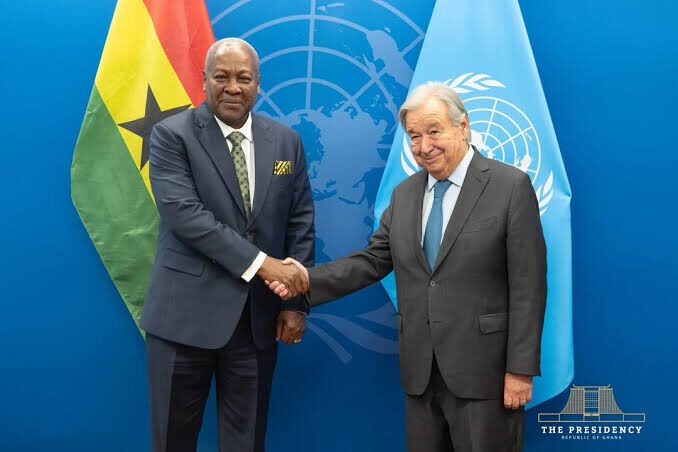
United Nations Secretary-General António Guterres has expressed support for the African Union’s growing reparatory justice agenda during discussions with Ghanaian President John Dramani Mahama on the sidelines of the 81st United Nations General Assembly.
The meeting placed one of Africa’s most important historical justice campaigns within the wider diplomatic conversations taking place in New York, where leaders have been discussing conflict, development, debt, artificial intelligence and reform of international institutions.
Ghana pushes reparatory justice onto global agenda
President Mahama has made reparatory justice an increasingly visible part of Ghana’s international engagement. The issue concerns the lasting consequences of slavery, colonialism and exploitation and the forms of acknowledgement, institutional reform and redress that affected societies believe should follow.
For Ghana, the debate also connects with the country’s historical role in Pan-Africanism and its relationship with African-descended communities in the Caribbean, the Americas and elsewhere.
What UN support could mean
Support from the UN Secretary-General does not by itself create a compensation programme or determine what reparations should look like. Those questions remain politically and legally complex. However, UN engagement can give the issue greater diplomatic visibility and provide a forum for countries to discuss possible frameworks.
Reparatory justice can include several ideas beyond direct financial compensation. Advocates have raised debt relief, development financing, return of cultural property, historical acknowledgement, institutional reform, educational initiatives and investment in communities affected by the legacies of slavery and colonialism.
African Union seeks coordinated approach
The African Union has sought to move the debate away from isolated national campaigns toward a more coordinated continental position. That approach is intended to give African states greater collective influence when engaging former colonial powers and international institutions.
Ghana has also been working with Caribbean partners, where governments have developed their own reparations initiatives through CARICOM. Cooperation between African and Caribbean states could become an important part of the campaign’s next phase.
Diplomacy beyond symbolism
The central challenge will be converting statements of support into concrete diplomatic processes. Governments differ over responsibility, legal liability, the passage of time and the appropriate forms of remedy. Supporters of reparatory justice argue that the continuing economic and social effects of historical exploitation make the issue contemporary rather than purely historical.
Mahama’s meeting with Guterres therefore represents another step in an effort to keep the subject within mainstream international diplomacy. The next test will be whether governments can move from broad acknowledgement of historical injustice toward specific areas where agreement is possible.

Leave a Reply