
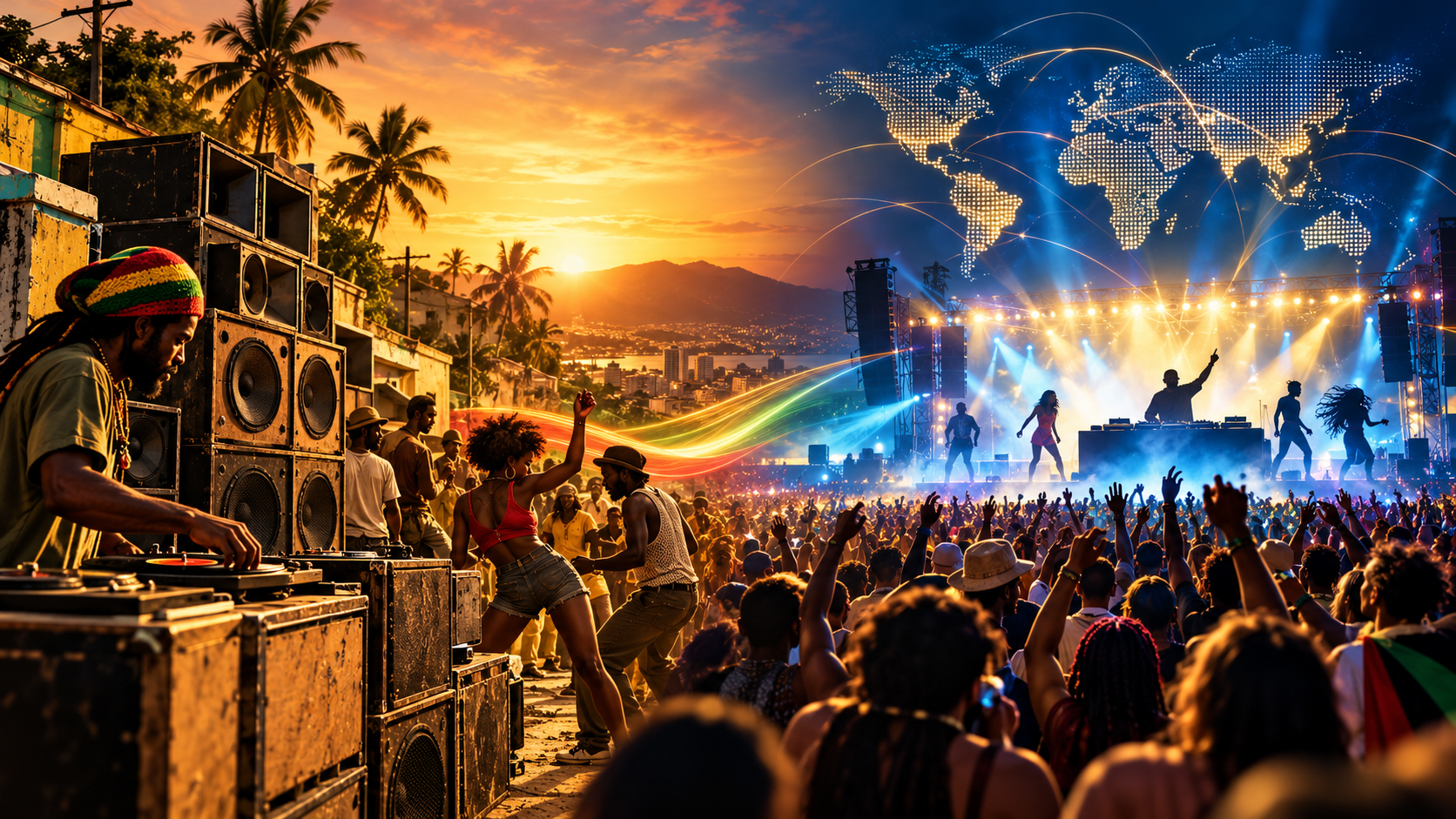
Dancehall is more than a musical genre. It is a culture built around rhythm, sound systems, language, fashion, dancing and the ability of an artiste to command an audience.
Emerging in Jamaica during the late 1970s and developing rapidly through the 1980s, dancehall grew from reggae traditions while creating a harder, more direct and increasingly digital identity of its own.
From early pioneers such as Yellowman and Barrington Levy through Shabba Ranks and Beenie Man to Sean Paul, Vybz Kartel, Popcaan and newer generations, dancehall has repeatedly reinvented itself. Its influence can now be heard far beyond Jamaica—in hip-hop, Afrobeats, reggaeton, electronic music and mainstream pop.
Before Dancehall: The Sound-System Foundation
To understand dancehall, it is necessary to understand Jamaica’s sound-system culture.
Long before streaming services and social media, powerful mobile sound systems provided entertainment in Jamaican communities. DJs selected records while performers known as deejays developed the practice of “toasting”—rhythmic talking, chanting and improvising over instrumental tracks.
The dance itself became a testing ground.
A new riddim could be played before a live crowd, different vocalists could record over the same instrumental, and selectors could determine quickly which songs generated the strongest response.
This relationship between the artiste, riddim, selector and audience became fundamental to dancehall culture.
Dancehall Emerges in the Late 1970s
By the late 1970s, Jamaican popular music was changing.
Roots reggae had become internationally recognised through figures such as Bob Marley, Peter Tosh and Burning Spear. Dancehall developed alongside that tradition but often emphasised the immediate realities and entertainment of Jamaican dance spaces.
Early dancehall recordings generally featured leaner arrangements and prominent bass and drums.
Artists including Yellowman, Barrington Levy, Eek-A-Mouse, Josey Wales and General Echo became important voices during dancehall’s early development.
The deejay was increasingly becoming the star.
Yellowman and the Rise of the Dancehall Deejay
Yellowman’s rise in the early 1980s demonstrated how powerful the dancehall deejay could become.
His distinctive delivery and stage presence helped take dancehall beyond Jamaica, while the competitive culture surrounding sound systems encouraged performers to develop unique voices and lyrical styles.
Dancehall was becoming more than an offshoot of reggae.
It was developing its own stars, vocabulary and identity.
Then technology changed everything.
“Sleng Teng” and the Digital Revolution
One of the most important turning points came in 1985 with Wayne Smith’s “Under Mi Sleng Teng.”
The electronically produced riddim helped accelerate the movement toward digital dancehall.
Producers no longer needed to rely exclusively on full bands to construct riddims. Drum machines, keyboards, synthesisers, and other electronic tools made production faster and opened new creative possibilities.
A single riddim could support recordings from numerous artistes.
The riddim culture that followed became one of dancehall’s defining characteristics.
Shabba Ranks Takes Dancehall International
During the late 1980s and early 1990s, dancehall’s international profile grew considerably.
Shabba Ranks became one of the genre’s biggest crossover stars, helping introduce Jamaican dancehall to audiences who previously knew Caribbean music primarily through reggae.
His success demonstrated that the rougher sound and rhythmic vocal delivery of dancehall could compete internationally.
Other major performers from this broad era included Ninjaman, Super Cat, Cutty Ranks, Buju Banton and Mad Cobra.
Dancehall was becoming an international product while remaining unmistakably Jamaican.
Beenie Man, Bounty Killer and the Clash Culture
The 1990s produced another powerful generation.
Two names became especially important: Beenie Man and Bounty Killer.
Their careers reflected dancehall’s deeply competitive nature. Rivalries, lyrical clashes and claims to supremacy became part of the culture.
Sound clashes had already established competition as a fundamental component of Jamaican music. Dancehall artistes carried that competitive energy onto records and stages.
At the same time, the genre expanded musically.
Some artistes concentrated on party records and sexuality. Others explored poverty, violence, spirituality, politics and social conditions.
Buju Banton, for example, increasingly incorporated roots-reggae themes into his music, demonstrating how fluid the boundary between reggae and dancehall could be.
Sean Paul Helps Dancehall Conquer Mainstream Pop
The early 2000s produced another international breakthrough.
Sean Paul became one of the most commercially successful Jamaican performers of his generation.
Songs such as “Gimme the Light,” “Get Busy” and “Temperature” introduced dancehall rhythms and Jamaican vocal styles to enormous international audiences.
Dancehall was increasingly appearing alongside American hip-hop and R&B.
International producers and pop stars began incorporating Jamaican-inspired rhythms, vocal patterns and production techniques.
Yet back in Jamaica, another transformation was taking place.
Vybz Kartel and the Digital Generation
Few artistes have influenced modern dancehall as significantly as Vybz Kartel.
Emerging from the previous generation and becoming increasingly dominant during the 2000s, Kartel developed an enormous catalogue and a distinctive lyrical style that influenced many younger performers.
His impact extended beyond individual songs.
Language, slang, fashion, lyrical techniques and youth culture became closely associated with his music and the wider Gaza movement.
The rivalry involving Kartel’s Gaza camp and Mavado’s Gully movement also became one of dancehall’s most famous modern competitive periods.
By this stage, the internet was transforming music consumption.
Dancehall no longer depended entirely on physical records, radio or traditional distribution.
Songs could circulate internationally almost immediately.
Popcaan and Dancehall’s New International Generation
Popcaan emerged from Kartel’s Portmore Empire and eventually developed his own international career.
His melodic approach demonstrated another direction for modern dancehall, blending traditional Jamaican delivery with increasingly atmospheric and internationally accessible production.
Artists such as Popcaan helped bridge Jamaican dancehall with hip-hop, R&B, Afrobeats and global pop.
Dancehall was evolving again.
Women Have Always Been Part of Dancehall’s Story
The history of dancehall cannot be properly told without its female performers.
Artists including Sister Nancy, Lady Saw, Tanya Stephens, Spice and others challenged a male-dominated industry and created influential catalogues of their own.
Sister Nancy’s “Bam Bam,” in particular, travelled far beyond its original Jamaican context and became one of the most recognisable Jamaican recordings internationally.
Later generations of women continued pushing boundaries surrounding sexuality, independence, fashion and female authority within dancehall.
Dancehall Travels to Africa
Dancehall’s influence across Africa became particularly significant.
Ghana developed a strong reggae-dancehall culture, while Nigerian and other African performers increasingly incorporated Jamaican rhythms, terminology and vocal techniques.
The relationship did not remain one-way.
As Afrobeats grew internationally, Jamaican and African artistes increasingly collaborated, creating musical exchanges between the Caribbean and Africa.
Ghana’s own reggae-dancehall scene has produced generations of performers who adapted Jamaican influences to local languages, rhythms and experiences.
This helped transform dancehall from simply an imported Jamaican genre into an influence that African artistes could reinterpret in their own ways.
Dancehall’s Influence on Global Pop
Dancehall’s international influence now extends far beyond songs officially classified as dancehall.
Its rhythms and production ideas have appeared throughout mainstream pop, hip-hop and electronic music.
Its influence is also connected to the development of reggaeton and other Caribbean and Latin urban styles, although those genres have their own distinct histories.
Perhaps even more important is dancehall’s influence on performance culture.
The importance of the DJ, riddim, remix, sound clash, dance moves, street slang and charismatic vocal delivery all travelled internationally.
From Sound Systems to Social Media
Technology has changed how dancehall reaches audiences, but some of its original principles remain surprisingly intact.
A Jamaican sound-system session once allowed a song to spread through a community.
Today, TikTok, YouTube, Instagram and streaming platforms can perform a similar function on a global scale.
A dance move can turn a song into an international trend. A freestyle can travel across continents within hours. An independent artiste can release music without waiting for a major record company.
In that sense, modern digital dancehall remains connected to its grassroots origins: create something powerful, play it for the people and allow the audience to decide its strength.
Dancehall Keeps Reinventing Itself
Dancehall has never remained frozen in one period.
The sound of Yellowman’s generation differs from Shabba Ranks. The 1990s differed from the Sean Paul era. Vybz Kartel’s generation changed it again, and today’s artistes continue experimenting with trap, Afrobeats, R&B and electronic production.
Arguments will inevitably continue over what constitutes “real dancehall.”
But change itself has always been part of the genre.
From Kingston’s sound systems to international stadiums and smartphones across Africa, Europe and the Americas, dancehall has survived because every generation has found a way to reinterpret it.
The riddims change. The technology changes. The artistes change. But the dancehall continues.

Leave a Reply